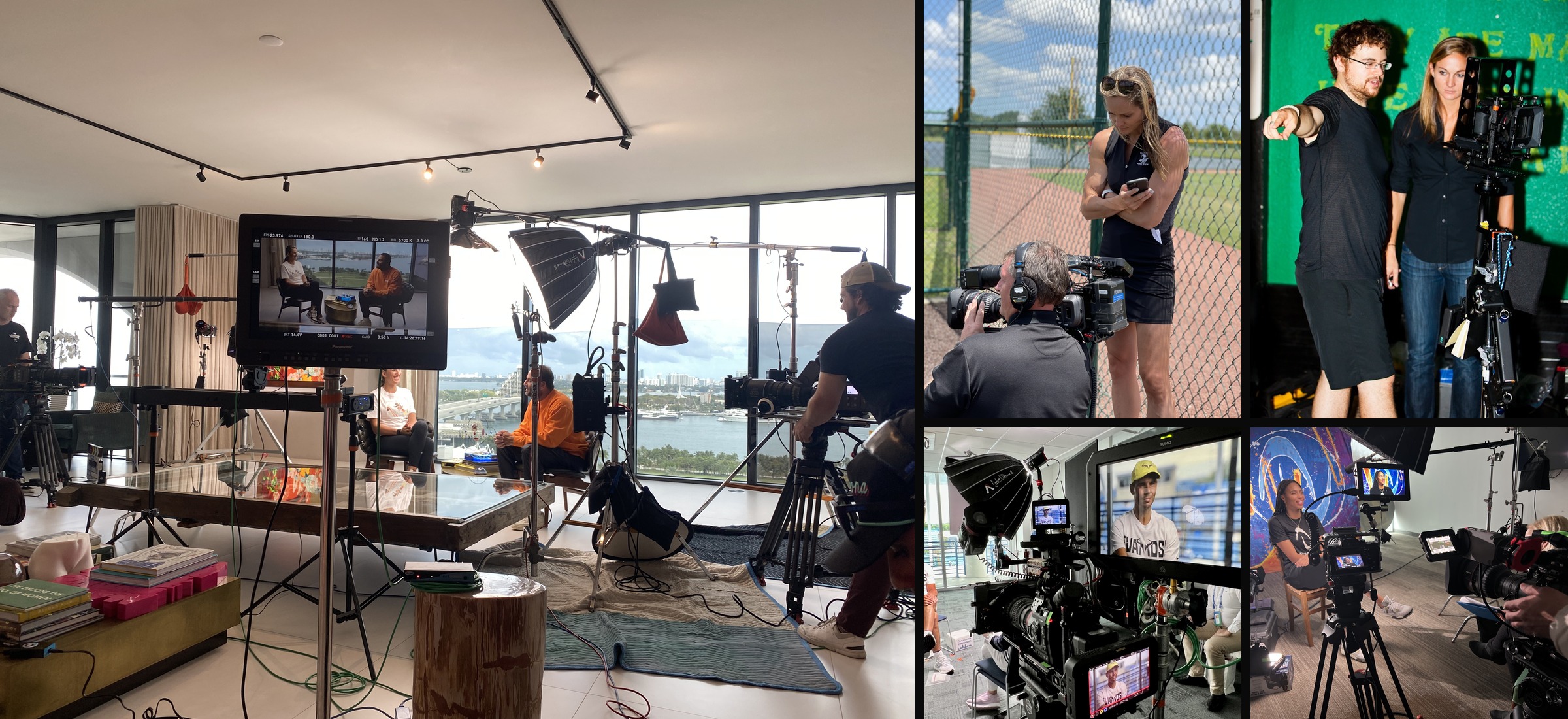
By Lesley Young, Founder and Executive Producer, Greyline Media
I went back through Greyline's work this year and tried to find one project that started with a cold email or a cold call.
I could not find one.
Every single job traces back to a person. Someone who worked a show with us. Someone who sat next to one of our producers in a truck at two in the morning. Someone who watched us handle a problem eight minutes before air and remembered how we behaved.
That is not a humblebrag. It is a strategic fact with two sides to it, and I want to be honest about both.
In most industries, a cold pitch can work because the buyer can try you cheaply and reverse the decision if it goes badly. Live sports has no undo. The show happens once, at a fixed time, in front of everyone.
So when a league, a club or a brand hires a production partner, they are not really buying cameras and crew. They are buying the confidence that when the transmission path drops at 7:05, somebody in that truck has been there before and does not panic.
You cannot put that in a deck. There is no case study that proves it. A reel shows you what went right, which is exactly the wrong evidence. The only real proof is a person who has watched you work when it was going wrong.
That is why this business runs on relationships, and why it always will. Trust does not arrive by email.
Here is where I will push back on my own side of the argument.
That sentence has become the most comfortable line in our industry, and very often it is an excuse. It grants permission to skip business development entirely and call it strategy. You go to the conference. You take the coffees. You post the wrap photo. Then you wait for the phone.
That is not relationship-led business development. That is hoping, with good manners.
The tell is concentration. If most of your revenue comes from one relationship, you do not have a relationship-based business. You have a single point of failure with a friendly face on it. I know that math intimately, and I would rather say so out loud than pretend otherwise, because naming it is what makes you fix it.
A relationship is not a pipeline. It is the reason a pipeline converts.
Cold calls fail here. That does not mean the alternative is passive. Done properly, relationship-led business development is more disciplined than outbound, not less. It just does not feel like selling, which is exactly why so many of us let it slide to the bottom of the list.
Four things I hold myself to.
Follow people, not logos. The coordinating producer you worked with in 2016 runs a league's content operation now. The associate who used to log for you is a brand's head of marketing. Logos never call you. People do. So keep a real list of people, know where they went, and reach out when they get the new job rather than when you need the work.
Give first, and keep it small. An introduction. A crew recommendation for a date you cannot cover. An honest read on a piece of gear. Twenty minutes helping someone scope a job you are not bidding. None of that is charity. It is how people find out what you are like to work with before there is any money involved.
Put it on the calendar. Relationship work that is not scheduled does not happen once the season starts. I block it the way I block a shoot day, because the alternative is doing it only in the months when work is thin, which is the worst possible time to start.
Treat your crew as your business development team. Every freelancer who has a great week with us tells three other people. Every one who gets paid late tells five. Our reputation is built far more by how we run a gameday than by anything I will ever say in a meeting.
I started at ESPN in 2007, as a temporary production assistant in Remote Production, on my twenty-second birthday. I learned the job from people who gave me hard feedback and expected me to use it.
The friends I made in that production trailer between 2007 and 2011 are still some of my closest friends. They are also, now, people running things.
That is what time in an industry actually buys you. Not a longer reel. A wider circle of people who already know exactly what you are like when a show is falling apart, so they never have to take a risk to hire you.
It is the throughline from On Her Turf at the Tokyo Olympics to the US Open, from Tampa Bay Sun FC and the Gainbridge Super League to championship golf. Different sports, different scale, mostly the same answer to the question of how it started: someone came back, or someone told someone.
The honest caveat is that this does not scale on its own. A network built since 2007 will keep producing work, but it produces roughly the work you already have. New rooms require deliberately walking into new rooms. That is the part I am spending real calendar time on this year, and it is uncomfortable in exactly the way growth usually is.
So no, we are not going to cold call you. But if you are a league, a club, a rights holder or a brand thinking about your coverage next season, I would like to be a person you know before you need one. Reach out anytime, or find me at the next event and say hello.